

A Novel Early Production Facility (EPF) Concept for Multi-Operator Field Tie-In Using Full-Range Multiphase Flow Metering and Model-Driven Optimization: Chadar–Faragh Fields, Libya
Authors: F. Shawesh1, M. Shnaib2, R. Iskibaev2
1Zallaf Libya Oil & Gas, Tripoli, Libya
2AlfanOil Group, Dubai, United Arab Emirates

Abstract
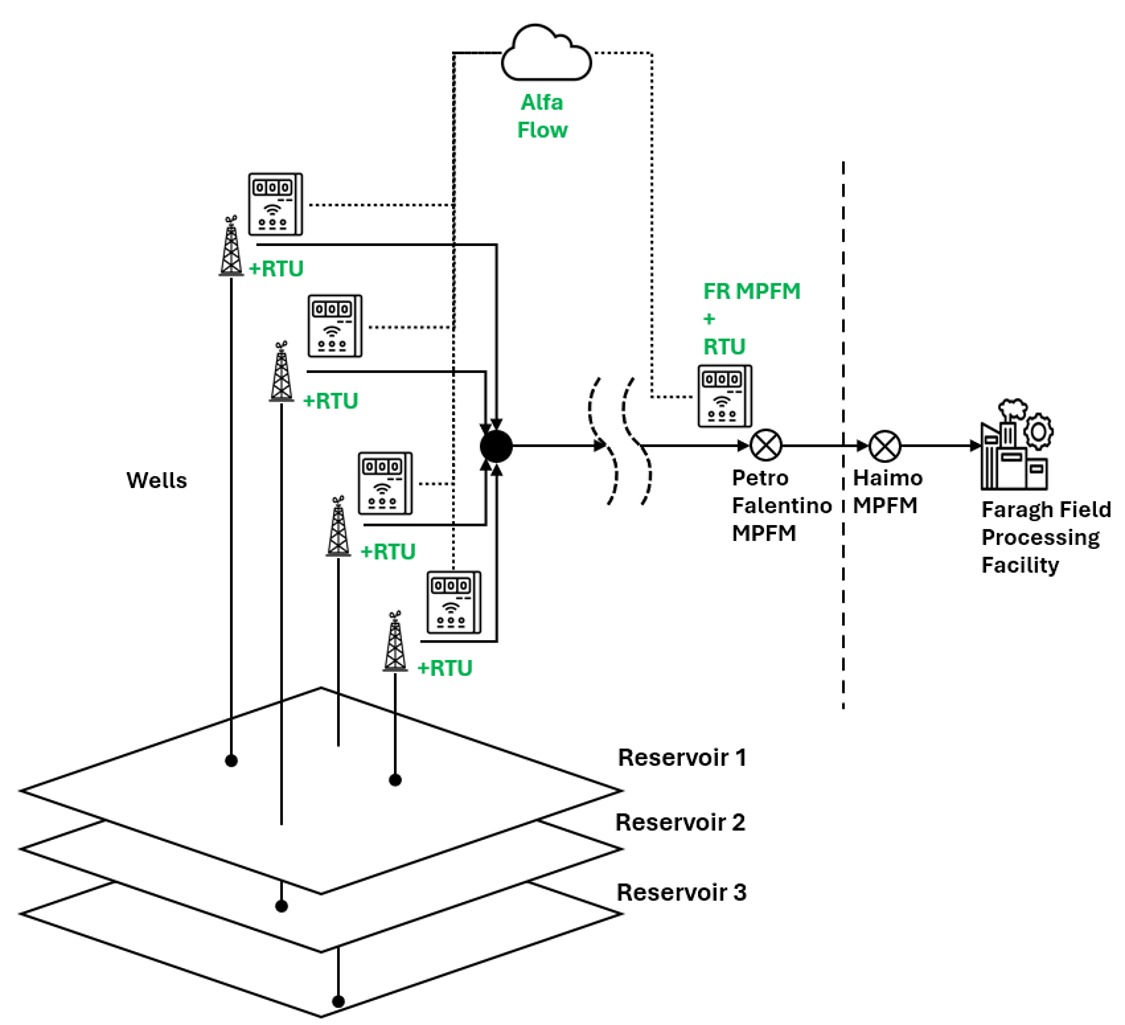
The development of marginal and early-stage oil fields in the MENA region is often constrained by high capital expenditures (CAPEX), extended project schedules, and the need for dedicated surface processing and custody metering infrastructure. This paper presents a novel concept implemented in the Chadar Field (Libya), which instead of Early Production Facility (EPF) enables direct tie-in of untreated multiphase production to a third-party processing facility operated at the Faragh Field. The proposed architecture eliminates upstream separation and dedicated processing trains, achieving CAPEX savings of 51–67% and reducing project execution time by 40–50%, while significantly accelerating first oil. The concept integrates allocation-grade full-range multiphase flow metering (FR MPFM), real-time digital optimization in modern software, and a multi-operator governance framework in concession. Field implementation achieved additional production rates of ~4,500 BOEPD and ~15 MMSCFD, with cumulative oil production exceeding 1.2 million BBLs during the initial operational phase.
Project Achievements & Operational Impact
-
Incremental Production due to Optimization:
- ~4,500 BOEPD (oil + gas condensate equivalent)
- ~15 MMSCFD of natural gas
- Incremental Oil & Gas Condensate Production: >1.2 million BBLs
- MPFM Availability: More than 98%, with only minor outages due to sand erosion
- CAPEX Savings: 51–67%
- Execution Schedule: Reduced project execution time by 40–50%
-
Multi-Operator Governance Model:
- Clear Contractual Frameworks
- Independent Verification
- Shared Data Transparency
Modernized Scenario with Closed-Loop Optimization
- FR MPFM Measurements: Continuous Oil, Gas & Water Rates at the commingled level
- Well Models: Built based on Lower & Higher Completion, Deviation Surveys, Head-Capacity Curves
- Periodic PLT Surveys: Distribution Production per each Layer / Reservoir
- Virtual Metering: Derived from Distributed Pressure and Temperature Data
-
Reconciliation Algorithm: Mass-Balance Approach based on Calibrated Well Models and Choke Settings that distributes field totals to:
- Wells
- Reservoirs
- Shareholders